
Trade Finance and Cross-Border Payments: Where Time Gets Lost in an Import Operation.
By Linka Finance
Approximately 70% of documents presented under letters of credit are rejected on first presentation, according to the International Chamber of Commerce's own assessment when it introduced UCP 600. For an import operation running on a tight production schedule, that single fact explains more about payment delays than any conversation about shipping times. LawTeacher
What an import operation actually looks like, step by step
A standard letter-of-credit transaction follows a fixed sequence: the buyer applies for the LC, the issuing bank transmits it to the seller's bank, the seller ships the goods, and then the seller has up to 21 days from the bill of lading date to present the required documents, unless the LC specifies otherwise. Once presented, the examining bank has a maximum of five banking days to determine whether the documents comply. Financely-groupFinancely-group
Each of those steps has a built-in window, and none of them assumes anything goes wrong. When something does a mismatched date, a missing signature, a description that doesn't match the LC text exactly the clock resets.
Why the documentation layer is where time actually disappears
Shipping delays get the attention because they're visible: a ship sits at port, a container misses a sailing. Documentation delays are less visible but more frequent. The most common discrepancies involve transport documents, commercial invoices, and insurance documents, per ICC Banking Commission data. When a discrepancy surfaces, the fix isn't automatic: an LC amendment typically requires agreement from the applicant, beneficiary, and both banks, and takes three to seven business days, days during which the goods may already be in transit or sitting at destination, and payment is frozen. DocShipperDocShipper
Layer on top of that the cross-border payment leg itself. Once documents are accepted and payment is due, correspondent banking routes the actual funds transfer through a chain of intermediary banks, each applying its own FX markup and processing window the same structural friction that drives up costs in any international B2B payment, not just trade-finance-specific ones.
Where the payment leg fits and where Linka fits into it
Linka doesn't remove documentation risk that's a legal and logistics discipline that sits with the buyer, seller, and their banks. What Linka addresses is the payment leg once funds need to move: settling the cross-border payment in under 24 hours using stablecoin rails (USDC/USDT), with a transparent commission between 2% and 6% depending on volume, instead of the multi-day correspondent banking window layered on top of an already-delayed documentation cycle.
For importers and exporters across Latin America, not only in Peru, but in markets like Bolivia, Colombia, El Salvador, and Honduras, this matters most in exactly the scenario above: documents finally clear, and the payment still needs to move without adding its own multi-day delay on top of what documentation already cost.
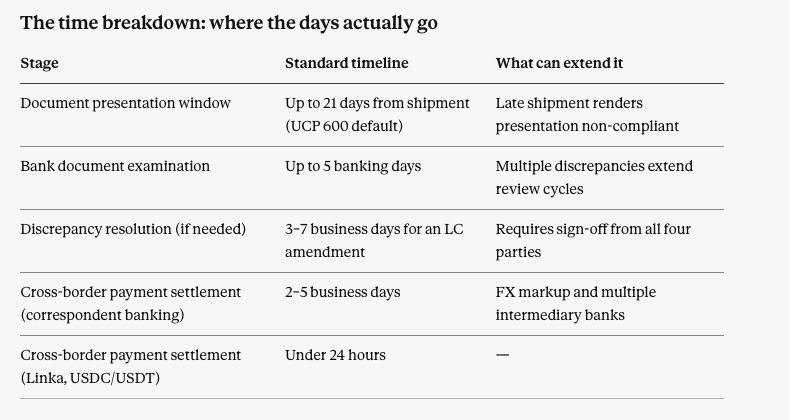
The 70% first-presentation discrepancy rate isn't a rare edge case it's closer to the norm. For a company running several import cycles a month, that means the documentation and payment layers, not the shipping lane, are usually the larger source of unpredictability in a treasury's cash flow forecast. LawTeacher
Frequently Asked Questions
Why do most import payment delays happen in documentation, not shipping?
Because letter-of-credit compliance is strict by design. Banks examine documents on their face against the LC's exact terms, and around 70% of first presentations contain at least one discrepancy, according to ICC data. A single mismatched date or description can freeze payment for days while it gets corrected or waived.
How long does it take to resolve a letter of credit discrepancy?
If the fix requires an LC amendment, expect three to seven business days, since it needs agreement from the applicant, beneficiary, issuing bank, and advising bank. Some discrepancies, like a bill of lading dated after the shipment deadline, can't be corrected at all and require a buyer waiver instead.
Does faster payment settlement fix documentation delays?
No, they're separate problems. Faster settlement (like Linka's under-24-hour USDC/USDT rail) addresses the payment leg once documents are accepted. It doesn't shorten the documentation examination period, but it prevents the payment step from adding its own multi-day delay on top of whatever the documentation cycle already cost.
What's the biggest lever a company has to reduce delays in its own import operations?
Pre-presentation document review. Companies that audit documents against the LC terms before bank presentation cut discrepancy rates significantly compared to those that don't, since most discrepancies are avoidable clerical or descriptive errors rather than substantive issues.
Does Linka replace the need for a letter of credit?
No. Linka addresses the cross-border payment settlement leg moving funds once payment is due not the documentary credit structure itself, which remains governed by UCP 600 and the buyer-seller-bank agreement.
What this means for your next import cycle
If your team is tracking cycle time on import operations, the data suggests the biggest lever isn't renegotiating shipping contracts it's documentation accuracy and payment settlement speed. Linka's team can walk through how the settlement leg specifically applies to your comex operations, contact us at linka.xyz.