
How to Pay International Suppliers Without Immobilizing Working Capital.
By Linka Finance
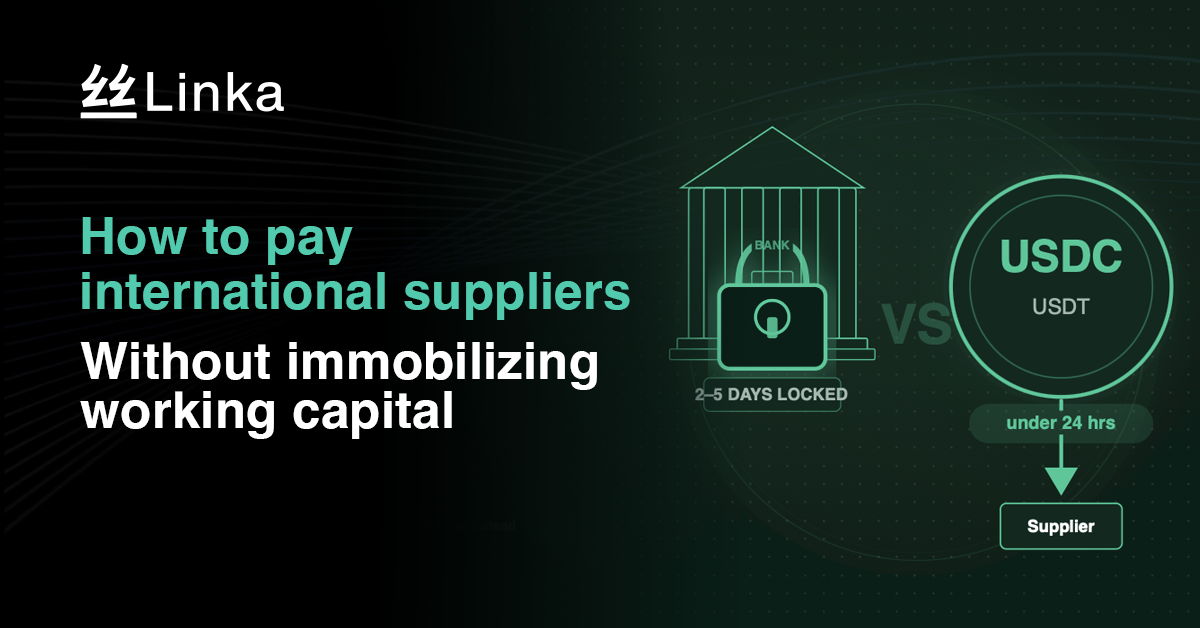
How to Pay International Suppliers Without Immobilizing Working Capital
Your bank shows a wire fee of $35. What it doesn't show is the 3 - 5% built into the exchange rate, the correspondent bank deduction that reduces what your supplier actually receives, and the 2–5 days your capital spends in transit, earning nothing, available to no one.
For importers, manufacturers, and trading companies across Latin America, this is the standard operating cost of paying international suppliers. And most of it never appears on a single line item.
The True Cost of a Wire Transfer
According to the World Bank's Remittance Prices Worldwide database, the average total cost of sending cross-border payments from G20 countries was 6.51% of the amount sent in Q4 2024. (CompareRemit) On top of that, international wire transfers through U.S. banks typically cost $35 - $50 per transaction, before intermediary and receiving fees. (BOSS Money)
These two figures the flat fee and the percentage, rarely appear together. But for a LATAM company paying a $100,000 invoice to a supplier in Asia or Europe, the combined impact looks like this:
- Wire fee: $35 - $50, paid upfront
- FX spread: 3 - 5% embedded in the exchange rate that's $3,000 - $5,000 on a $100K payment
- Correspondent bank deductions: variable, deducted mid-transfer, often unknown until the supplier reports receiving less than expected
- Float: 2–5 business days of immobilized capital that cannot be used for inventory, payroll, or operations
That last point compounds over time. On $10 million per month in cross-border payments, a 2–5 day settlement window means roughly $333,000 is in transit at any given time. (Polygon) That's capital that belongs to the company but is functionally inaccessible every single month.
For businesses where cash flow is tight and working capital windows are short, waiting more than a week for a payment to clear can disrupt operations and damage supplier relationships. (Intelligent CIO LATAM) According to a 2025 Mastercard/PCMI study on SME cross-border payments in Latin America, banks still handle 75% of cross-border payment flows for SMEs (Intelligent CIO LATAM) , not because the system is optimal, but because switching has historically required more complexity than most finance teams want to take on.
That's changing.
Why Traditional Fixes Fall Short
The common responses, credit lines, factoring, extended supplier terms, don't solve the problem. They finance around it.
A credit line covering payments while funds are in transit adds a financing cost on top of an existing settlement delay. Factoring converts a receivable into liquidity, but at a discount. Extended payment terms require negotiating leverage that most LATAM companies don't have relative to Asian or European manufacturers.
None of these tools address the root cause: a payment infrastructure built on correspondent banking that was designed decades before same-day settlement was technically possible.
How Stablecoin Rails Work and What They Actually Cost
USD-pegged stablecoins specifically USDC and USDT allow businesses to move dollar-denominated value across borders without routing through the correspondent banking chain.
The operational flow is straightforward:
- The company converts local currency to USDC or USDT through a licensed provider.
- The stablecoin is transferred to the supplier's wallet, or to a platform that converts it to fiat at the destination.
- Settlement completes in minutes to hours, 24 hours a day, 7 days a week.
Traditional cross-border payments through banks can cost 2–7% when accounting for transfer fees, FX spreads, and intermediary charges. Stablecoin-based payments, by contrast, settle in under three minutes and operate around the clock. (BVNK)
The net cost difference is real and documented. Among organizations currently using stablecoins, 41% reported cost savings of at least 10%, primarily in B2B cross-border payments using USD-denominated stablecoins. (EY) BVNK's Stablecoin Utility Report 2026, surveying 4,600 users across 15 countries, found stablecoin transfers cost an average of 40% less than traditional channels. Polygon
One honest caveat: on/off-ramp fees and local currency conversion still apply at the fiat edges of the transaction. The savings come primarily from removing float, eliminating correspondent bank deductions, and replacing opaque FX spreads with visible conversion costs not from making every component free.
Adoption reflects this. Fireblocks' 2025 survey found that 71% of Latin American financial institutions are already using stablecoins for cross-border payments the highest regional adoption rate globally. (Polygon) And the use case that drives the most interest: paying suppliers across borders, cited by 77% of organizations as their top stablecoin priority over the next five years. (EY)
How Linka Handles This for LATAM Businesses
For importers and trading companies across Latin America that need to pay international suppliers in USD without managing crypto infrastructure directly, Linka provides the operational layer.
Linka settles international B2B payments in under 24 hours using USDC and USDT rails. No foreign bank account required. No blockchain expertise needed on the treasury side. The platform handles conversion, transfer, and fiat delivery to the supplier.
The cost is stated before the transaction is confirmed: a commission of 2 - 6% depending on volume and corridor. That figure is visible upfront not embedded in a rate or deducted by a correspondent bank the company never chose.
Linka operates across Latin America, headquartered in Peru, and manages KYC, AML, and transaction compliance the regulatory layer that makes cross-border stablecoin payments viable for businesses that don't want to own that complexity internally.
The Shift Is Already Underway
B2B stablecoin payments have surged from under $100 million monthly in early 2023 to over $6 billion by mid-2025 a 60x increase in 30 months. (AlphaPoint)
In the US–Mexico corridor alone, Bitso processed $6.5 billion in cross-border volume in 2024 roughly 10% of the entire corridor with same-day settlement and competitive FX rates. (Polygon)
And regulatory clarity is accelerating the transition. The US GENIUS Act, signed in July 2025, established the first federal framework for payment stablecoins, materially reducing regulatory risk for LATAM businesses whose payment flows originate in the United States. (Polygon)
The infrastructure exists. The cost data is public. For LATAM companies running significant monthly volumes in international supplier payments, the math is worth running.
Linka can walk you through the comparison for your specific corridors and volumes. Contact the team at linka.xyz.