
USDC and USDT for Businesses: Differences, Risks, and Use in Corporate Treasury
Por Linka Finance
USDC and USDT both trade at the same $1.00, but they don't share the same issuer, the same reserve composition, or the same regional backing. For a treasury team settling international payments in stablecoins, that distinction determines what counterparty risk the company is taking on and, increasingly in Latin America, which token has direct institutional support behind it.
Why This Distinction Matters Now
Stablecoins are no longer a niche instrument. The combined market cap of USDT and USDC alone sits at roughly $190 billion and $72 billion respectively, together accounting for about 83% of the entire stablecoin market. That scale has moved the asset class from speculative territory into something regulators, auditors, and corporate treasurers now have to account for directly. Stablecoin issuers collectively hold enough US Treasury bills that their position surpasses the holdings of countries like Germany and Saudi Arabia a detail that signals how embedded these instruments have become in dollar-denominated finance.
For a LATAM import/export company, the practical question isn't whether stablecoins are legitimate. It's which one to hold, for how long, and which issuer has actually built infrastructure in the region rather than just entered it.
Where the Two Actually Diverge
Issuer and reserve composition. USDC is issued by Circle, with reserves in cash and short-dated US Treasuries, largely managed by BlackRock, and published in monthly attestations. USDT is issued by Tether, whose reserves have historically included a broader mix of assets, and whose reserve composition draws more frequent external scrutiny than USDC's.
Liquidity and reach. USDT leads by a wide margin on raw liquidity, exchange availability, and daily transaction volume the practical factors that matter most for a treasury team that needs to move value quickly across counterparties in Asia, LATAM, and beyond. USDC remains the preferred instrument on DeFi platforms and, since March 2026, has overtaken USDT in adjusted transaction volume, a measure of actual payment activity rather than parked balances but USDT's ubiquity is what makes it the default settlement asset for most cross-border trade counterparties today.
Regional backing. This is where the gap is most concrete for a LATAM company. Tether has been actively investing in the region's fintech infrastructure backing platforms like Ualá in Argentina, Parfin, and Plenti's expansion into Peru and Bolivia. Closer to home, Tether has held Linka in its investment portfolio since 2024, and according to Linka CEO Víctor Egoávil, Linka is the only Peruvian company in that portfolio, a distinction reported by CriptoTendencia in September 2026. That backing isn't incidental to how Linka operates: USDT is the stablecoin Linka uses to extend trade-finance liquidity directly to Peruvian importers and exporters, letting a business receive working capital while the local leg of the transaction settles separately in domestic currency.
Why Treasury Policy Should Name the Stablecoin, Not the Category
A treasury policy that says "we accept stablecoins" without specifying which one leaves a gap. USDC and USDT differ in issuer, reserve composition, and regional infrastructure differences that translate directly into different counterparty profiles and different practical liquidity for a given trade corridor. A company holding stablecoin balances for days or weeks, rather than passing them through in a same-day settlement, is exposed to whichever of those profiles applies to the token it's holding.
The regulatory environment adds a second layer worth tracking. The US GENIUS Act, signed into law on July 18, 2025, is the first federal legislation to establish a licensing and regulatory framework for payment stablecoins, requiring issuers to maintain reserves on a 1:1 basis in a narrow set of highly liquid assets, with monthly reserve reports certified by the issuer's CEO and CFO. Implementation rules were still open for public comment as of mid-2026, with an effective date targeted for January 2027.
How This Plays Out in Cross-Border Payments
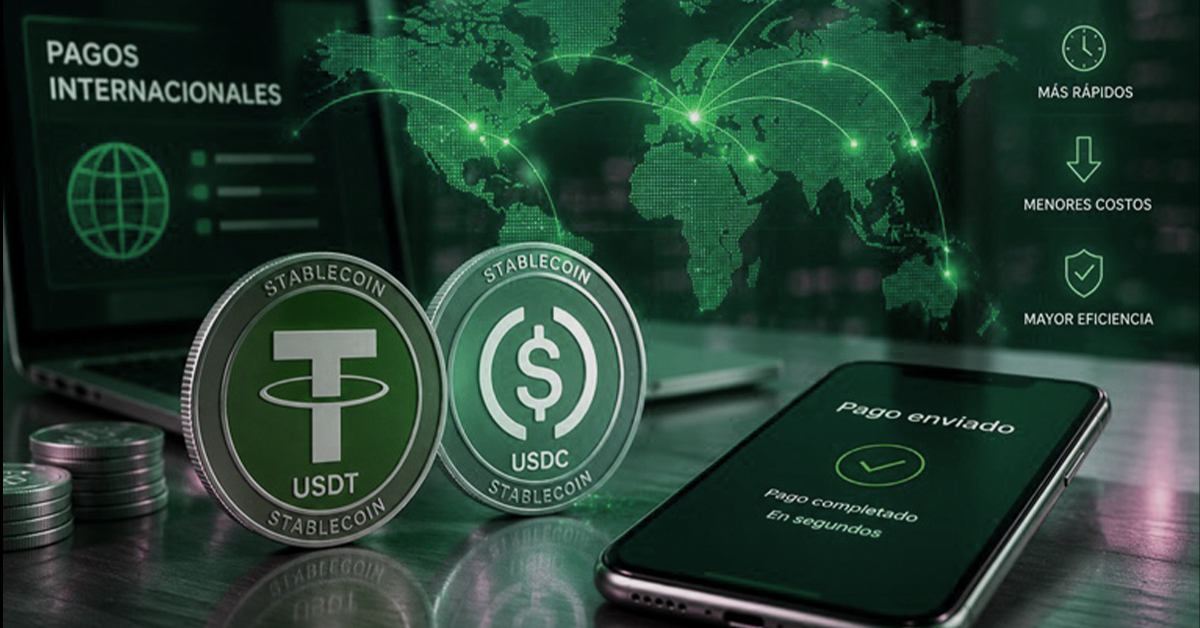
For a treasury team paying suppliers in Asia or receiving payment from a buyer in Europe, the choice of stablecoin rail is not academic it affects settlement speed, how easily counterparties on the other side already hold or accept the token, and how the position converts back to fiat. This is the gap Linka addresses operationally: Linka settles B2B international payments in under 24 hours using stablecoin infrastructure primarily USDT, backed by Tether's direct investment in the company since 2024 with a transparent commission between 2% and 6% depending on volume and no hidden FX spread layered on top. For Peruvian importers and exporters specifically, Linka extends USDT-denominated financing directly, covering the gap between shipping goods and receiving international payment, while the domestic leg settles in local currency.
The Data Treasury Teams Should Track
Stablecoin use in B2B payments grew sharply in 2025, and the underlying trend is worth watching rather than the headline multiplier alone: transaction volume through these rails is increasingly driven by actual commercial settlement rather than trading activity, according to industry data compiled from DefiLlama, the BIS, and Binance Research. For a CFO evaluating a provider, issuer backing is a data point worth asking for directly not just market cap, but who has invested in the platform's regional infrastructure and since when.
FAQ
What's the main difference between USDC and USDT for a business?
USDC is issued by Circle with reserves largely in cash and short-term US Treasuries, published in monthly attestations. USDT is issued by Tether, leads by a wide margin on liquidity and exchange availability, and has built a growing base of direct investments in LATAM fintech infrastructure including Linka.
Does Tether have a direct relationship with Linka?
Yes. Linka has been part of Tether's investment portfolio since 2024 and is the only Peruvian company in that group.
Why does Linka use USDT specifically for trade finance?
USDT's liquidity and exchange availability make it the practical settlement asset for cross-border trade counterparties, and Tether's direct backing of Linka since 2024 supports the company's USDT-denominated working capital financing for Peruvian importers and exporters.
Does the GENIUS Act change how businesses should use stablecoins?
The GENIUS Act establishes the first US federal licensing framework for payment stablecoin issuers, with rules still in the comment period as of mid-2026 and an effective date targeted for January 2027. It sets a compliance baseline companies can use to evaluate which stablecoins meet a minimum regulatory bar going forward.
Should a company hold stablecoin balances or only pass them through?
Holding stablecoins for extended periods means carrying whatever issuer profile applies to that token. Using stablecoins as a settlement rail for same-day or next-day international payments, as Linka does, limits that exposure window considerably.
What This Means for Your Treasury Policy
USDC and USDT are not substitutes for each other, and for a LATAM company, the practical question includes which issuer has actually invested in the region's payment infrastructure. Linka's use of USDT is backed directly by Tether's investment in the company since 2024 a concrete answer to that question, not just a token choice. If your treasury is starting to route international payments or trade financing through stablecoin rails, Linka's team can walk through the settlement flow and financing options with you contact us at linka.xyz.