
B2B International Payments: How USDC Settlement Works Across Latin America
Por Linka Finance
Banks are the most expensive channel for moving money across borders, averaging a 14.99% cost as of the World Bank's Q3 2025 report, more than double the global average of 6.36% across all payment service providers. Banks remain the most expensive type of service provider, with an average cost of 14.99 percent. For a B2B treasury moving six or seven figures a month, that gap isn't a rounding error. It's a line item that rarely gets its own line. World Bank
Why cross-border B2B payments are still slow and expensive
A typical international supplier payment in LATAM still routes through a chain of correspondent banks. Each one applies its own FX markup, handling fee, and compliance check before the funds move to the next link. The structural problem is that this chain has been thinning for over a decade: the number of active correspondent banking relationships worldwide fell 22% between 2011 and 2019, according to BIS CPMI data drawn from SWIFT messaging flows. Fewer direct relationships mean more intermediary hops for corridors that aren't a bank's core business and LATAM corridors fall into that category more often than not. Opendue
The result for a CFO paying an overseas supplier: settlement windows of two to five business days, an FX spread that's rarely disclosed as a separate line, and a final amount the counterparty receives that can differ meaningfully from what was quoted at initiation.
Why traditional rails fall short for LATAM treasuries
Correspondent banking was built for high-volume corridors between large banks in developed markets. LATAM-to-Asia or LATAM-to-Europe supplier payments are exactly the kind of lower-volume, higher-friction corridors that this infrastructure treats as an afterthought. The cost isn't just the fee it's the capital sitting idle in transit, the reconciliation work when the received amount doesn't match the invoice, and the forecasting error introduced by unpredictable settlement timing.
How USDC settlement works operationally
This is the gap Linka addresses. By routing B2B payments through stablecoin rails, Linka eliminates the correspondent banking chain that generates most of the hidden cost. Settlement happens in under 24 hours. The cost is a single transparent commission between 2% and 6% depending on volume with no spread applied on top.
Operationally, the flow looks like this: the paying company transfers funds to Linka, which converts to USDC or USDT and settles on-chain to the recipient's designated corridor, converting to local currency or dollars as needed at the destination. Because the transfer moves on a blockchain rail rather than through a series of nostro/vostro accounts, there's no multi-day float and no stacked intermediary fees. Linka operates across Latin America not only in Peru, where it's headquartered, but across markets including Bolivia, Colombia, El Salvador, and Honduras giving treasuries a consistent settlement process regardless of corridor.
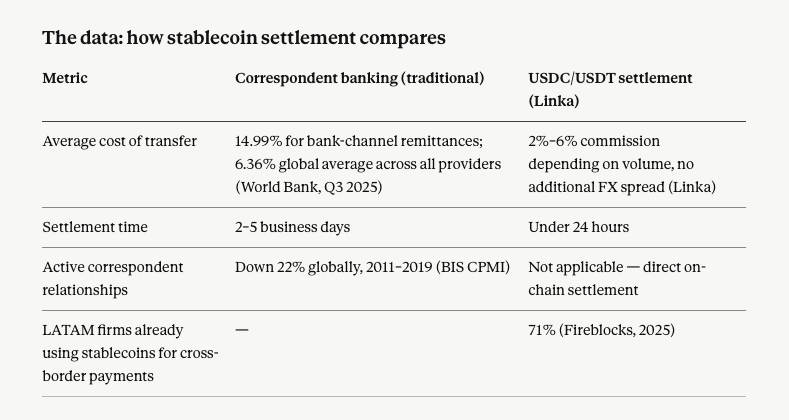
This isn't a marginal gap. It's the difference between a payment that clears before your supplier's next production run and one that stalls it.
Regional adoption backs up the shift in behavior, not just the cost case. 71% of Latin American firms already use stablecoins for cross-border payments, per Fireblocks' 2025 data. In Brazil specifically, over 90% of crypto flows are now stablecoin-related, and in Argentina, stablecoins accounted for more than half of all Argentine Peso exchange purchases between July 2024 and June 2025, according to Chainalysis. At a global level, B2B use is the fastest-growing segment of stablecoin payments overall: B2B transactions reached $226 billion in 2025, a 733% year-over-year increase, per the McKinsey and Artemis Analytics baseline published in February 2026. That's not speculative trading volume it's actual payment activity, net of internal transfers and liquidity noise. Tazapay + 3
Frequently Asked Questions
How do B2B international payments with USDC actually settle?
The paying company transfers funds to a provider like Linka, which converts them to USDC and settles on-chain to the recipient's market, converting to local currency or USD at the destination. Settlement typically completes in under 24 hours, compared to 2–5 business days through correspondent banking.
Is USDC settlement regulated in Latin America?
Regulatory treatment varies by country. Brazil regulates virtual asset service providers under its Virtual Assets Law (14,478/2022), Argentina introduced mandatory VASP registration in 2025, and other markets are developing frameworks at different speeds. Companies should confirm licensing status with their provider for each specific corridor.
What does USDC settlement cost compared to a bank wire?
Bank-channel international transfers average 14.99% in total cost, according to the World Bank's Q3 2025 Remittance Prices Worldwide report. Stablecoin settlement through Linka charges a single commission of 2%–6% depending on volume, with no additional FX spread layered on top.
Why do companies use USDC instead of holding USD directly?
USDC gives companies a dollar-denominated instrument that moves on blockchain rails 24/7, without requiring a US bank account or exposure to the multi-day settlement windows of correspondent banking. It functions as a transport mechanism, not a treasury asset companies hold long-term.
Does this replace the need for a bank account?
No. Companies still need banking relationships to receive local currency and manage day-to-day operations. Stablecoin settlement replaces the cross-border leg of the payment, the part that historically ran through correspondent banks, not the entire banking relationship.
What this means for your treasury
If your company is paying suppliers or receiving payments across borders in LATAM, the cost of correspondent banking isn't disappearing on its own; the data shows it's been structurally embedded for over a decade. The first step is understanding the actual spread on your last 10 international transactions, including fees that don't show up as a single line item. Linka's team can run that analysis with you and walk through how USDC settlement would apply to your specific corridors contact us at linka.xyz.