
Letter of Credit vs. Stablecoins: Comparing Time and Cost in Trade Finance
Por Linka Finance
A letter of credit can cost as little as 0.1% of the transaction value — cheaper on paper than most stablecoin payment rails. It can also take up to three weeks to clear, and roughly 60–70% of document presentations get flagged with a discrepancy on the first try, according to ICC-based studies (Impello Global, A Beginner's Guide to Letters of Credit, 2026), which restarts part of the clock. For a comex operator deciding how to pay or get paid on a shipment, the real comparison isn't which instrument looks cheapest on a fee schedule. It's what each one actually costs once time, corrections, and the working capital tied up in between are counted.
What a Letter of Credit Actually Costs
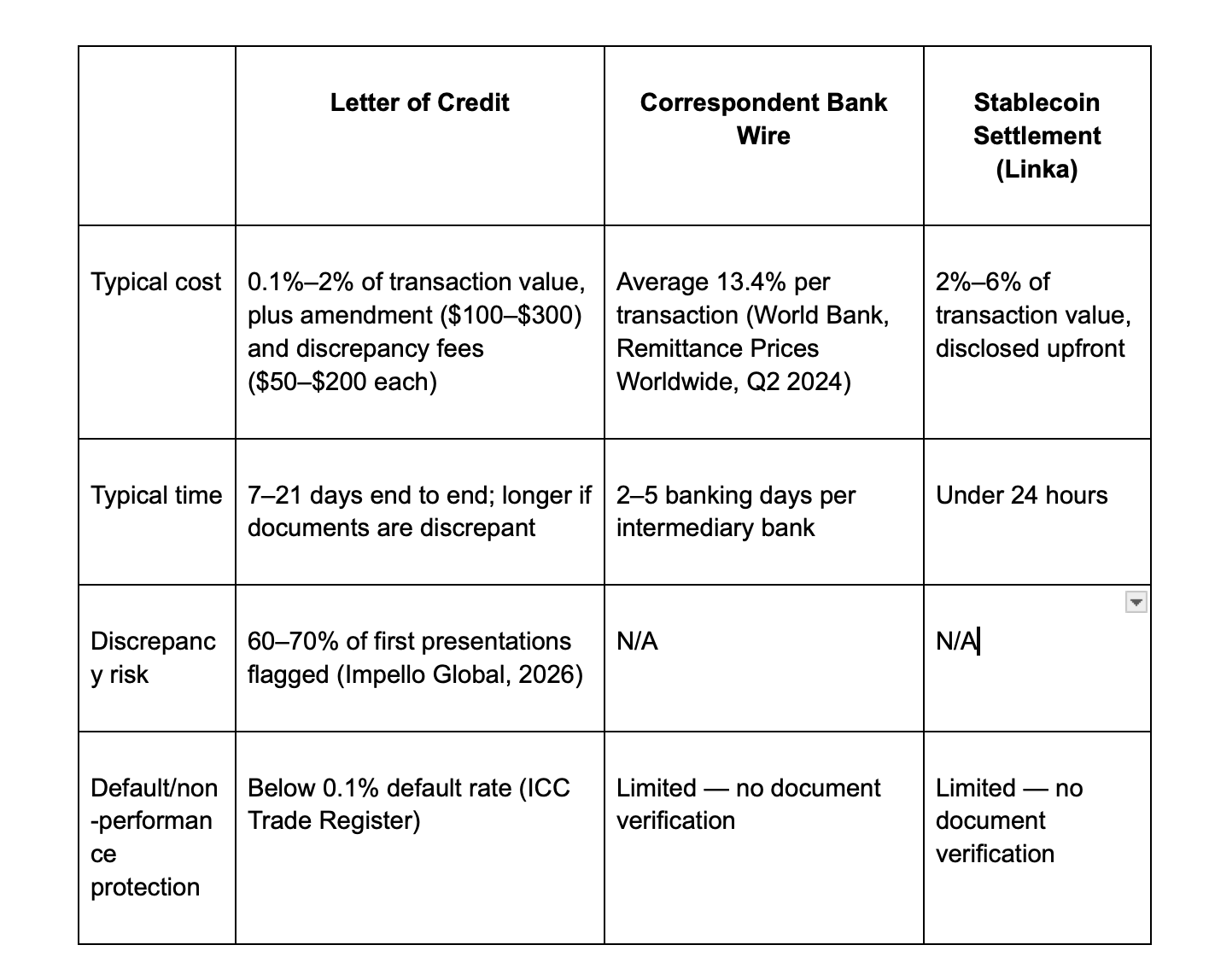
LC pricing is layered, not a single number. The issuing bank typically charges 0.75% to 1.5% of the LC value for issuance, and the advising bank adds another 0.25% to 0.75% for document review and compliance checks (Trade Financer, What Are the Costs Associated with Letters of Credit?, 2024). If the exporter requires a confirmed LC — common when trading with a counterparty in a higher-risk market — that adds a further layer of cost on top. Altogether, total LC pricing usually falls between 0.1% and 2% of the transaction value (Trade Treasury Payments, Letters of Credit, 2025).
Two costs get added after issuance, and they are the ones that catch operators off guard: an amendment fee of $100 to $300 for any change to the LC's terms, which also extends processing by three to five days, and a discrepancy fee of $50 to $200 charged per discrepancy found in the presented documents (DocShipper, Letter of Credit: Complete Definition & Guide, 2026; Trade Financer, 2024). Neither is rare. In exchange for that cost, LCs carry one of the lowest default rates in trade finance — below 0.1%, according to ICC Trade Register data — which is precisely why exporters accept the added expense when working with an unfamiliar buyer.
What a Letter of Credit Actually Takes
Under typical conditions, the full LC process — from application through document presentation to payment — takes 7 to 21 days, depending on document accuracy, bank processing speed, and shipping arrangements (Okumarkets, Letters of Credit Process: 7 Key Steps, 2025). Once documents are presented, the examining bank has up to 5 banking days under UCP 600 rules to determine whether the presentation complies, and payment on a compliant sight LC generally follows within 5 to 7 banking days of that determination (DocShipper, 2026).
The variable that breaks this timeline is the same one driving the discrepancy fees above: an estimated 60–70% of initial document presentations contain at least one discrepancy, ranging from a misspelled name to a mismatched shipment date (Impello Global, 2026). When that happens, the exporter has three options — correct and re-present the documents within the LC's validity period, ask the buyer to waive the discrepancy (which the buyer can refuse or use as leverage for a discount), or ship the documents on a collection basis and lose the LC's payment protection entirely (DocShipper, 2026). Any of the first two paths adds days; the third removes the reason to use an LC in the first place.
What Changes With Stablecoin Settlement
A stablecoin payment removes the document-driven mechanic entirely. There is no presentation to examine, no discrepancy to flag, and no amendment cycle — the payment either sends or it doesn't. Linka settles international supplier payments in under 24 hours, with a single, transparent commission of between 2% and 6% depending on volume, disclosed before the transaction rather than assembled from issuance, advising, amendment, and discrepancy fees after the fact.
That speed and simplicity comes with a real trade-off, and it is worth stating plainly: a stablecoin payment does not replicate the independent verification an LC provides. An LC's entire value proposition is that a bank — not either trading party — confirms the shipping documents match the agreed terms before releasing funds, which is exactly why LCs remain the standard for first-time counterparties or higher-risk trade corridors. A direct stablecoin payment is a faster, cheaper settlement rail; it is not, on its own, a substitute for the document verification and non-performance protection an LC provides. For companies with an established, trusted supplier relationship — where the LC's core function is payment speed and cost rather than counterparty verification — the comparison shifts toward whichever instrument settles the transaction with the least friction.
Letter of Credit vs. Stablecoin Settlement, Side by Side
FAQ
How much does a letter of credit typically cost?
Total pricing usually falls between 0.1% and 2% of the transaction value, made up of an issuance fee (0.75%–1.5%), an advising fee (0.25%–0.75%), and additional charges for confirmation, amendments ($100–$300), or discrepancies ($50–$200 each) if they arise.
Why do so many letter of credit transactions get delayed?
Because an estimated 60–70% of initial document presentations contain at least one discrepancy — a misspelled name, an incorrect quantity, a late shipment date — which forces a correction-and-re-presentation cycle before the bank will release payment.
How long does it take to get paid under a letter of credit?
The full process, from application to payment, typically takes 7 to 21 days under normal conditions. Once compliant documents are presented, payment on a sight LC generally follows within 5 to 7 banking days.
Is a stablecoin payment as secure as a letter of credit?
Not in the same way. An LC's core value is that a bank independently verifies shipping documents before releasing funds, which protects against non-performance. A stablecoin payment is a faster, lower-friction settlement rail, but it does not include that independent verification step.
When does it still make sense to use a letter of credit instead of stablecoins?
When trading with a new or higher-risk counterparty where document-based verification and the bank's payment guarantee are worth the added cost and time — that protection is the LC's main function, not a byproduct of it.
Does Linka offer an alternative to bank wires for paying international suppliers?
Yes. Linka converts local currency into digital dollars and settles international supplier payments in under 24 hours, with a transparent commission of between 2% and 6% depending on volume.
Choosing the Right Instrument for the Transaction You Actually Have
The letter of credit and the stablecoin payment are not solving the same problem. One verifies that a shipment happened the way both parties agreed; the other moves money fast and predictably once that trust already exists. A comex operator working with a new counterparty in an unfamiliar market has good reason to accept an LC's cost and timeline. A company paying a supplier it already trusts, on a schedule that can't absorb a three-week cycle, has equally good reason to look elsewhere.
If your company is evaluating how it pays international suppliers, Linka's team can walk through where a document-based instrument still makes sense and where a stablecoin settlement rail would save time and cost, at linka.xyz.